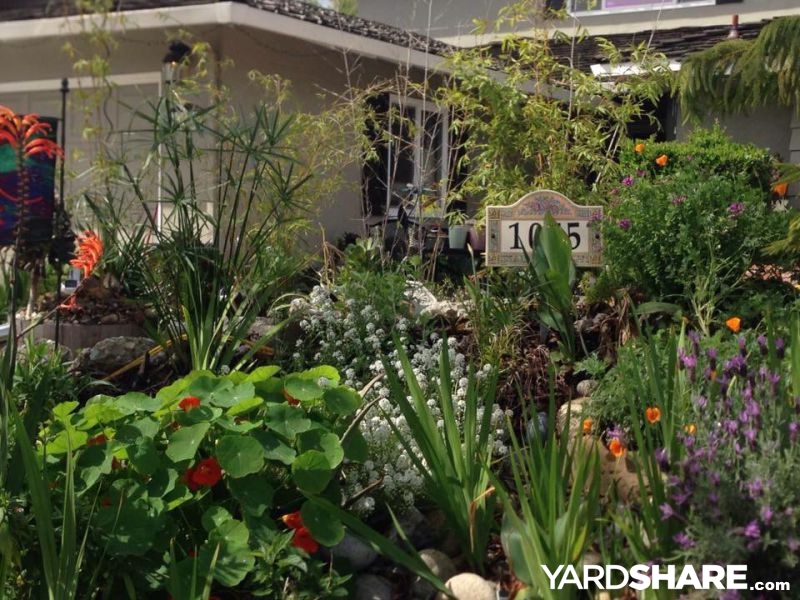
Julie's front bed in spring, full of green leaves, red nasturtium flowers, white alyssum, and orange poppies in front of the house.
Some front yards start with a plan and a contractor. Julie RG started hers in November 2014 with a borrowed truck, a wish to use less water, and other people's leftover building materials. Her San Jose front yard, in Zone 9, is now a lawn-free courtyard of stone walls, paths, and planted beds. She calls it the "Stone Soup Courtyard Project," and the name fits. Like the soup in the old story, it was made bit by bit from what neighbors had to share.
Start with free stuff and a borrowed truck
"I started a project at home in November of 2014 to re-do my front yard to make it more drought tolerant and water-friendly," Julie writes, "using all FREE recycled/up-cycled materials, with no contractors or previous knowledge of construction."
The materials list reads like a neighborhood clean-out: pavers, bricks, cement chunks, moss, succulents, plants, mulch, gravel, sand, river rock, dirt, and bulbs, donated by neighbors and found through freecycle and craigslist. In one photo caption she figures she brought home about 80 pickup truckfuls of free materials in all, some of them hauled in a friend's truck she borrowed now and then.
The whole project cost about $3,000, she writes, most of it for materials she could not source for free, plants, and a few days of hired help when she was under a deadline. The rest was her own work, with help at times from her kids and her husband.
Urbanite walls you can plant in
The backbone of the yard is broken concrete, the chunks Julie and other gardeners call urbanite. She stacked it into retaining walls, flower beds, and stairs up from the sidewalk. It is heavy, plain work, and the early photos show piles of it waiting their turn.
Then she planted the walls themselves. "So the best thing about the urbanite walls is you can plant things in them!" she writes. She tucked hundreds of tiny sedums and succulents into the crevices, along with bulbs and ground cover. By spring, she writes, plants were "coming out of the living wall. It just exploded with life and color. The bees were very happy!"
That is the lesson to copy even at a smaller scale. A low wall or a raised bed edge has gaps. Fill the gaps with tough little plants instead of leaving bare stone, and the hard work starts looking soft and green within a season or two.
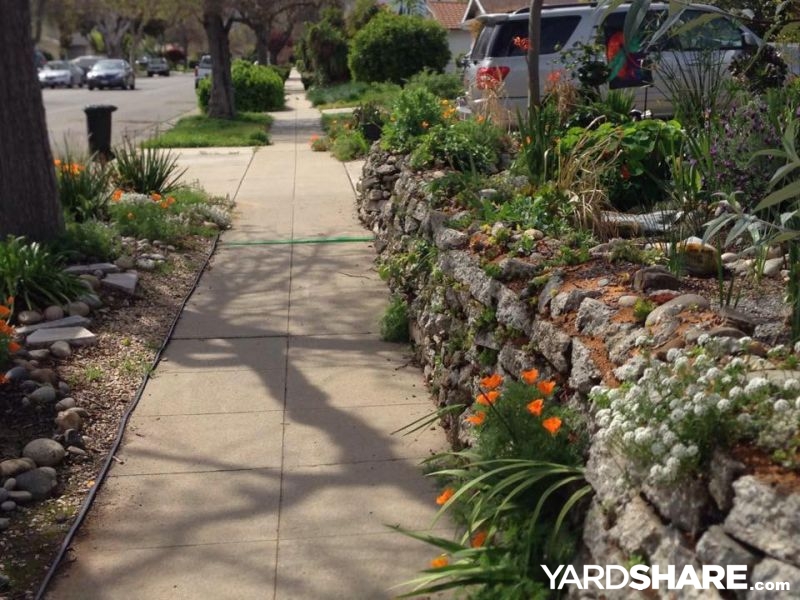
The urbanite living wall along the sidewalk, covered with green plants, white alyssum, and orange poppies.
A rain garden in the middle
Water was the point of the whole project, so the yard does more than skip the lawn. Julie sheet mulched the old grass, laid concrete chunks as pavers, and dug a rain garden with help from her kids. "My kids helped me dig a huge hole and I lined it with newspaper and covered it with stones," she writes. "Now it is a rain garden so water pools there and returns to the water table underground."
The finished front beds make her favorite point for her. In her words: "Drought-tolerant doesn't have to mean desert-like. I love the tropical lushness!" The spring photos back her up. Nasturtiums, poppies, alyssum, and tall green leaves crowd the beds, and nothing about the yard looks dry or bare.
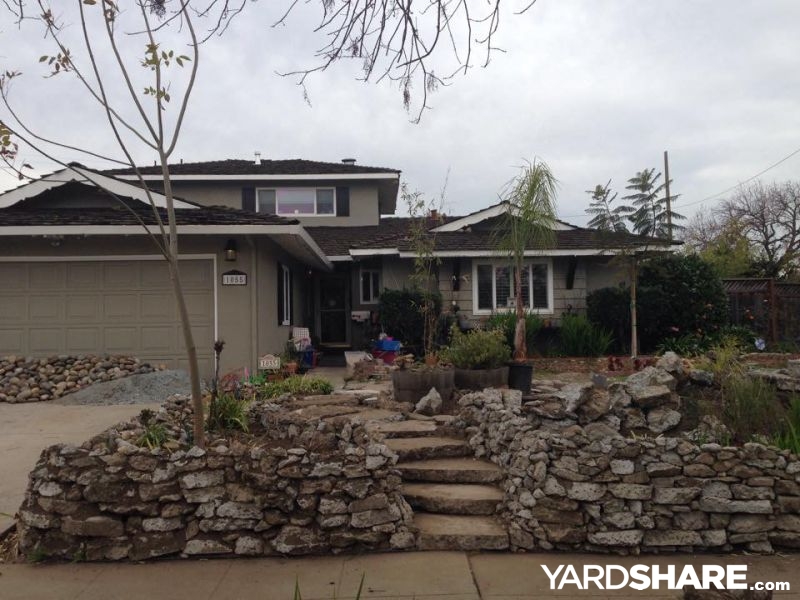
The front of the house, with urbanite walls on both sides and stone stairs leading up the middle.
Why look at this yard in November
Julie started in November, and November is still a good month to start a yard like this in Zone 9. The first jobs are not planting jobs. They are gathering, sheet mulching a lawn you want gone, and stacking stone while the weather is cool. The planting that fills the crevices can follow as you go.
She is also honest about what the work gave back. The thousands of hours, she writes, were "very therapeutic," helped her through the death of a dear friend, and gave her a place to host guests and neighbors. A front yard built from shared materials became a place where people gather. That may be the most copyable part of all.
Three things to borrow from Julie's courtyard:
- Ask before you buy. Pavers, bricks, broken concrete, plants, and mulch often go free when a neighbor finishes a project. A borrowed truck can be the whole supply chain.
- Plant the walls. Tuck sedums, succulents, and ground cover into the gaps in stone walls and bed edges, and let them soften the stone.
- Keep the rain. A shallow, stone-covered rain garden gives roof and path runoff a place to soak in instead of running to the street.
See more like it
- Julie's yard, all 46 photos: CA water-wise, lawn-free, sustainable, front courtyard
- Water-wise ideas: water-wise yards
- Front yard ideas: front yard yards
- Stone and rock ideas: stone and rock yards
- Gardens in Julie's climate: Zone 9 yards